
Insurance Advice for the Festive Season: What to Do After an Accident
Step-by-Step: What to Do After an Accident
- Stay Calm & Check for Injuries
First, make sure everyone in your vehicle is safe. Only move if it’s safe to do so. - Move to a Safe Place (if possible)
If your car is drivable, pull over to avoid blocking traffic or causing another accident. - Call for Help
Contact emergency services immediately if there are injuries or major damage. - Exchange Details
Share your name, ID, contact, and insurance details with the other driver(s). - Take Photos
Snap pictures of all vehicles, damages, license plates, and the scene from different angles. - Collect Witness Info
Get the contact details of anyone who saw the accident. - Report to Your Insurer
Contact your insurer within 24 hours to start the claims process. - File a Police Report
This is essential for insurance claims. Be sure to get a case number.
South African Emergency Numbers
- Police: 10111
- Ambulance/Fire: 10177
- ER24: 084 124
- Netcare 911: 082 911
- AA Roadside Assistance: 0861 000 234
- Insurance Claims Helpline: (See your policy for your insurer’s direct line)
Wright Business Partners’ Extra Tips
- Keep your licence and insurance details in your glove box.
- Save your insurer’s emergency number in your phone.
- Don’t admit fault at the scene—just state the facts.
- Only use tow trucks approved by your insurer.

Smart Tax Tips for South Africans: Maximise Your Returns in 2025
Tax season doesn’t have to be stressful. With the right knowledge and preparation, you can ensure compliance while maximising your tax benefits. Here are essential tax tips every South African taxpayer should know.
1. Understand Your Tax Deadlines
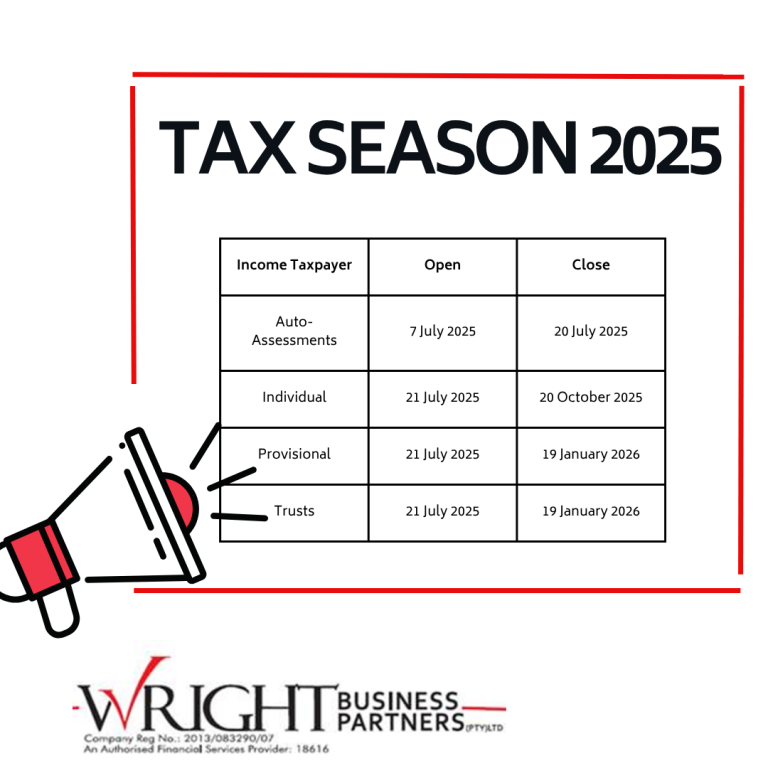
SARS operates on strict deadlines. For the 2024/2025 tax year:
Individuals (non-provisional): Typically October 2025
Provisional taxpayers: January 2026
Companies: 12 months after financial year-end
Missing deadlines results in penalties, so mark your calendar early and submit well in advance.
2. Maximise Your Retirement Contributions
Retirement annuity contributions are one of the most effective tax deductions available. You can deduct up to 27.5% of your taxable income (capped at R350,000 annually) for contributions to:
Retirement annuities
Pension funds
Provident funds
Example: If you earn R500,000 annually and contribute R100,000 to your RA, you could save approximately R27,000 in tax (depending on your tax bracket).
3. Claim All Allowable Deductions
Don’t leave money on the table. Common deductions include:
Medical expenses: Contributions to medical schemes and qualifying out-of-pocket expenses
Travel allowance: Keep a detailed logbook of business vs. private travel
Home office expenses: If you work from home, claim a portion of rent, utilities, and internet
Donations: Contributions to registered PBOs (up to 10% of taxable income)
4. Keep Impeccable Records
SARS can request supporting documents for up to five years. Maintain organised records of:
Payslips and IRP5 certificates
Medical aid certificates and expense receipts
Travel logbooks with dates, distances, and purposes
Donation receipts (Section 18A certificates)
Investment statements and interest certificates
Going digital with cloud storage ensures you never lose critical documents.
5. Don’t Ignore Additional Income
Many taxpayers forget to declare:
Rental income from properties
Freelance or side-hustle earnings
Interest from savings accounts (above the exemption threshold)
Foreign income
Undeclared income can trigger audits and penalties. When in doubt, declare it.
6. Take Advantage of Tax-Free Savings Accounts
TFSAs offer tax-free growth on investments. You can contribute up to R36,000 annually (lifetime limit of R500,000). All interest, dividends, and capital gains are completely tax-free—a powerful wealth-building tool.
7. Plan for Capital Gains Tax
If you’ve sold property, shares, or other assets, you may owe Capital Gains Tax. Remember:
Individuals receive an annual exclusion of R40,000
Only 40% of the gain above this threshold is taxable
Primary residence sales have a R2 million exclusion
Proper planning can significantly reduce your CGT liability.
8. Review Your Tax Bracket Regularly
As your income grows, you move into higher tax brackets. Understanding where you stand helps you:
Plan retirement contributions strategically
Time bonuses and income for tax efficiency
Make informed decisions about salary vs. dividend structures (for business owners)
9. Use Professional Help When Needed
Tax laws are complex and constantly evolving. Professional assistance ensures:
You claim every deduction you’re entitled to
Your returns are accurate and compliant
You’re prepared for potential audits
You receive strategic advice for tax planning
The cost of professional tax services often pays for itself through savings and peace of mind.
10. Stay Informed About Tax Law Changes
SARS regularly updates tax rates, thresholds, and regulations. Recent changes include:
Adjustments to tax brackets and rebates
Two-pot retirement system implementation
Changes to medical tax credits
Staying current ensures you’re always compliant and taking advantage of new benefits.
Common Tax Mistakes to Avoid
Waiting until the last minute: Rush jobs lead to errors and missed deductions
Not updating personal details: Ensure SARS has your current contact information
Ignoring SARS correspondence: Respond promptly to any queries or requests
Claiming fraudulent deductions: The penalties far outweigh any short-term gain
Not reviewing your auto-assessment: Always verify that SARS has captured everything correctly
The Bottom Line
Effective tax management is about more than just filing returns—it’s about strategic planning throughout the year. By staying organised, understanding available deductions, and seeking professional guidance when needed, you can minimise your tax liability while remaining fully compliant.
Need expert tax assistance? Wright Business Partners has over 30 years of experience helping South African individuals and businesses navigate tax complexity. From simple returns to comprehensive tax planning, we’re here to ensure you keep more of what you earn.
Contact us today to discuss how we can optimise your tax position and give you peace of mind during tax season and beyond.

10 Essential Bookkeeping Tips for Small Business Owners in South Africa (2025 Guide)
Running a small business in South Africa means juggling a hundred tasks at once. Between serving customers, managing staff, and growing your revenue, bookkeeping often falls to the bottom of your to-do list. But here’s the truth: poor bookkeeping is one of the fastest ways to lose money, miss tax deadlines, and make costly financial mistakes.
Whether you’re a builder in Gauteng, an attorney managing trust accounts, or a farmer tracking seasonal income, solid bookkeeping isn’t just about compliance—it’s about understanding where your money goes and making smarter business decisions.
After 30+ years helping South African business owners get their finances right, we’ve seen every bookkeeping mistake in the book. Here are 10 essential tips to keep your business financially healthy and stress-free.
1. Separate Your Business and Personal Finances Immediately
This is non-negotiable. Mixing personal and business expenses is the number one mistake we see—and it creates chaos at tax time.
What to do:
Open a dedicated business bank account
Get a business credit card
Never use business funds for personal purchases (and vice versa)
Why it matters: When everything’s mixed together, you can’t accurately track profit, claim legitimate tax deductions, or prove expenses during a SARS audit. Separation = clarity.
2. Track Every Single Transaction (Yes, Even the Small Ones)
That R50 cash payment for parking? The R200 coffee meeting with a potential client? Record it.
Small expenses add up fast, and they’re often tax-deductible. More importantly, untracked spending creates gaps in your financial picture.
Pro tip: Use accounting software that syncs with your bank account to automatically capture transactions. Manual entry is fine for cash purchases—just snap a photo of the receipt and log it immediately.
3. Keep Your Receipts Organized and Accessible
SARS requires you to keep financial records for five years. Shoebox accounting doesn’t cut it.
Best practices:
Digitize receipts using your phone or scanner
Store them in cloud-based folders organized by month or category
Label files clearly (e.g., “2025-03-Office-Supplies”)
Why it matters: If SARS audits you or you need to claim expenses, you’ll need proof. Missing receipts = lost deductions and potential penalties.
4. Reconcile Your Bank Accounts Monthly (At Minimum)
Bank reconciliation means comparing your bookkeeping records with your actual bank statements to catch errors, fraud, or missing transactions.
How often? Monthly is the baseline. Weekly is better if you have high transaction volume.
What to look for:
Duplicate entries
Bank fees you forgot to record
Payments that didn’t clear
Fraudulent transactions
Catching discrepancies early prevents bigger headaches later.
5. Understand the Difference Between Profit and Cash Flow
Just because your income statement shows profit doesn’t mean you have cash in the bank. This is a critical mistake that sinks businesses.
The issue: You might have outstanding invoices (profit on paper) but no cash to pay suppliers or staff.
The solution: Track cash flow separately. Know when money is coming in, when bills are due, and maintain a cash reserve for lean months.
6. Set Aside Money for Tax Throughout the Year
Don’t wait until tax season to think about what you owe SARS. Provisional tax payments are due twice a year, and VAT (if registered) is due every two months.
Smart strategy:
Open a separate savings account for tax
Transfer a percentage of every payment you receive (typically 20-30% depending on your tax bracket)
Work with an accountant to estimate your tax liability accurately
Why it matters: Scrambling to pay a massive tax bill in one lump sum can cripple your cash flow. Spreading it out keeps your business stable.
7. Know Your Deductible Business Expenses
Many small business owners overpay tax because they don’t claim legitimate deductions.
Commonly missed deductions in South Africa:
Home office expenses (if you work from home)
Vehicle expenses (fuel, maintenance, insurance—if used for business)
Professional development and training
Bank fees and accounting software subscriptions
Marketing and advertising costs
Important: Keep detailed records and only claim expenses that are genuinely business-related. SARS takes a dim view of personal expenses disguised as business costs.
8. Use Accounting Software (Not Just Spreadsheets)
Spreadsheets are better than nothing, but they’re time-consuming, error-prone, and don’t scale as your business grows.
Benefits of accounting software:
Automatic bank feeds reduce manual data entry
Built-in invoicing and payment tracking
Real-time financial reports at your fingertips
Easy tax preparation and VAT submissions
Popular options in South Africa include Sage, Xero, QuickBooks, and Pastel. Choose one that fits your business size and complexity.
9. Review Your Financial Reports Regularly
Your financial reports tell the story of your business health. Don’t wait until year-end to look at them.
Key reports to review monthly:
Profit & Loss Statement: Are you making or losing money?
Balance Sheet: What do you own vs. what you owe?
Cash Flow Statement: Where is your cash coming from and going?
Actionable insight: Regular reviews help you spot trends, cut unnecessary costs, and make informed decisions about hiring, investing, or expanding.
10. Work With a Professional Bookkeeper or Accountant
Here’s the reality: bookkeeping takes time, expertise, and attention to detail. If you’re spending hours every week wrestling with spreadsheets, that’s time you’re not spending growing your business.
When to hire help:
You’re consistently behind on bookkeeping tasks
You don’t understand your financial reports
You’ve made costly mistakes (missed tax deadlines, incorrect VAT submissions)
Your business is growing and the workload is overwhelming
What to expect: A good bookkeeper or accountant doesn’t just crunch numbers—they provide strategic advice, help you avoid costly mistakes, and give you peace of mind that your finances are accurate and compliant.
At Wright Business Partners, we’ve helped thousands of South African businesses—from farms to law firms to construction companies—get their bookkeeping right. Our clients stay with us for 20+ years because we don’t just handle the numbers; we help them understand their finances and make smarter decisions.
Final Thoughts: Bookkeeping is Your Business Foundation
Good bookkeeping isn’t glamorous, but it’s the foundation of every successful business. It helps you:
Make informed decisions based on real data
Avoid expensive tax penalties and compliance issues
Understand your true profitability
Plan for growth with confidence
Start with these 10 tips, and you’ll be ahead of 90% of small business owners. And if you need help getting your bookkeeping sorted, we’re here.
Ready to Take Control of Your Business Finances?
Stop stressing about bookkeeping and start focusing on what you do best—growing your business. At Wright Business Partners, we offer comprehensive bookkeeping, tax, payroll, and financial reporting services tailored to South African businesses of all sizes.
Get started today:
Call us: (011) 394-7511
Email: admin@wrightbizz.co.za
Let’s simplify your finances and set your business up for long-term success.